
How To Avoid Scholarship Fraud
Protecting students and families from deceptive financial aid schemes in an evolving digital landscape
With college costs continuing to climb and families searching for every possible source of financial assistance, scholarship fraud has become an increasingly sophisticated problem in 2026. Criminals exploit the stress and urgency surrounding educational funding decisions, deploying advanced tactics including AI-generated correspondence and professional-looking websites designed to deceive even cautious applicants. Understanding how to identify and sidestep these schemes requires awareness of both traditional warning signs and the newer methods fraudsters employ across digital platforms where students now spend much of their time searching for opportunities.
Understanding The ThreatThe Rising Tide of Financial Aid Deception

The overall environment for consumer fraud has grown substantially more dangerous in recent years. According to FTC data, consumers reported losing over $12.5 billion to fraud in 2024, representing a 25 percent increase from the previous year. While this figure encompasses all types of fraud rather than scholarship schemes alone, it demonstrates the scale of the threat landscape that students and families navigate when seeking educational funding. The FBI’s Internet Crime Complaint Center recorded $16.6 billion in reported cyber-enabled losses during that same period, with an average loss of approximately $19,372 among those who reported losing money.
The college financing system presents an attractive target for criminals due to several structural factors. Families face time-pressured decisions about financial aid applications, enrollment deposits, and scholarship deadlines. This urgency makes scarcity-based tactics particularly effective, with messages warning recipients they must respond within hours or miss their chance. Additionally, legitimate financial aid comes from numerous different sources—federal agencies, state programs, colleges, and private foundations—each operating with different processes and communications styles. This fragmentation makes it easier for scammers to impersonate legitimate organizations without raising immediate suspicion.
FTC data reveals that younger adults lost money to fraud more frequently than older adults, with scams originating on social media and through text messages causing substantial losses. Students actively searching for financial aid through these channels face heightened exposure to fraudulent offers.
Common Deceptive Tactics in Student Aid Schemes
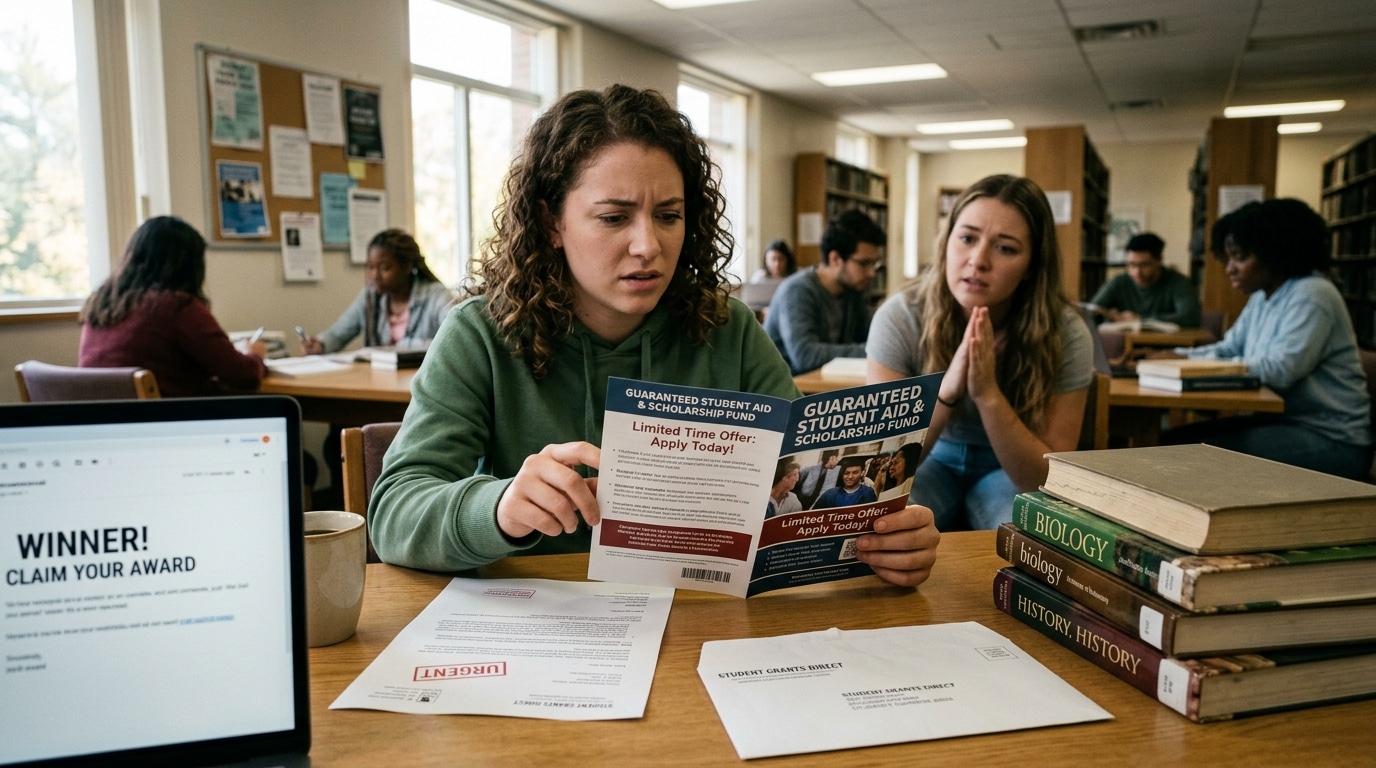
Recognizing the telltale signs of fraudulent scholarship offers remains the most effective defense against losing money or sensitive information. Modern scholarship scams typically follow familiar patterns despite their increasingly polished presentation. Criminals now employ sophisticated websites, professional branding elements, and correspondence that may be generated using artificial intelligence to appear legitimate at first glance. Nevertheless, certain characteristics consistently reveal fraudulent intent.
Messages announcing that a recipient has been selected for an award or named a finalist in a competition they never entered represent one of the clearest warning signs. Authentic scholarship programs operate through application processes where candidates actively submit their credentials for evaluation. Random notifications of unexpected winnings almost always indicate fraud. Similarly, any organization promising guaranteed scholarship money in exchange for payment operates outside the bounds of legitimate financial aid. No reputable scholarship provider can assure an applicant they will receive funding before reviewing their qualifications.
Authentic scholarships never require fees for processing, taxes, or application costs. Any request for money to receive an award signals fraud.
Deadlines measured in hours rather than weeks, combined with warnings about limited spots, aim to prevent verification efforts.
Demands for Social Security numbers, bank account credentials, or FSA ID login information before any legitimate award process.
Sponsors lacking verifiable physical addresses, clear staff information, or transparent eligibility requirements deserve heightened scrutiny.
How Scammers Exploit Online Platforms and Technology

The digital environment presents unique challenges for students attempting to distinguish legitimate opportunities from fraudulent ones. Today’s applicants discover scholarships through search engines, social media feeds, text messages, short-form videos, and sponsored advertisements. These same channels serve as primary hunting grounds for criminals who understand student behavior patterns and can tailor their approaches accordingly. Fraudulent scholarship promotions may appear as polished social media posts, sponsored content designed to blend with legitimate offerings, or personalized messages that seem specifically crafted for the recipient.
Some schemes involve criminals offering to complete the Free Application for Federal Student Aid on behalf of families, claiming their services can help applicants qualify for greater financial assistance in exchange for processing fees. The FAFSA remains free to complete, and allowing unknown third parties to handle this documentation creates serious risks. Beyond the immediate financial loss from fees, providing false information on federal aid applications—which scammers may do to make their promises appear fulfilled—can result in penalties including fines up to $20,000 or imprisonment.
Identity-based financial aid fraud has become sufficiently widespread that the Department of Education has implemented nationwide identity-validation changes for federal student aid programs. This systemic problem affects not only individual victims but can also create administrative burdens for legitimate students facing additional verification requirements.
Confirming Whether a Financial Aid Offer Is Authentic

Students possess several reliable methods for investigating whether scholarship opportunities are genuine before sharing personal information or making any payments. The most trusted resource available to most applicants is their school’s financial aid office, where staff members can confirm whether they recognize organizations offering awards and identify characteristics that raise concerns. School counselors similarly maintain familiarity with legitimate local and national scholarship programs and can provide guidance about unfamiliar opportunities.
Independent research offers another layer of protection. Searching online for an organization’s name combined with terms like “scam” or “reviews” often surfaces reports from previous victims or consumer protection warnings. Legitimate scholarship sponsors maintain professional websites with verifiable physical addresses, clear contact information, and staff details that exist independently from the initial outreach. If an organization claims government affiliation or offers government-related funding, confirmation should come directly through official government websites with .gov domains rather than taking such claims at face value.
When direct answers prove difficult to obtain, this itself serves as valuable information. Real organizations typically respond clearly to basic questions about their selection criteria, previous recipients, funding sources, and organizational history. Evasive responses or an inability to provide fundamental details suggests the opportunity may not be legitimate.
Before responding to any scholarship offer, verify the sponsor through independent channels such as your school’s financial aid office, conduct online searches for scam reports, confirm the organization has a legitimate web presence separate from their outreach, and consult state consumer protection resources if concerns persist.
Steps to Take After Encountering a Suspected Scam

Anyone who believes they have been contacted by scholarship scammers should immediately cease all communication with the suspected fraudster and avoid providing any additional information or payment. Documenting the encounter by saving screenshots, emails, and any payment records creates evidence that may prove useful for reporting purposes and potential recovery efforts. Even if no financial loss has occurred, reporting the attempted fraud helps authorities track criminal operations and warn other potential victims.
The Federal Trade Commission accepts fraud reports through ReportFraud.ftc.gov, providing a centralized mechanism for documenting scholarship scams along with other consumer protection complaints. For internet-based fraud, the FBI’s Internet Crime Complaint Center at ic3.gov serves as an appropriate reporting destination. When the fraud specifically involves student loans, financial aid programs, or impersonation of education officials, the Department of Education Office of Inspector General Fraud Hotline accepts reports at oig.ed.gov. State attorneys general offices also handle consumer protection matters and may investigate patterns of fraud affecting residents.
Those who have already shared financial information with suspected scammers should contact their bank immediately to report the potential compromise and discuss protective measures. If login credentials for StudentAid.gov accounts or FSA ID information have been disclosed, prioritizing account security through password changes and monitoring for unauthorized activity becomes essential. Taking rapid action following potential identity exposure significantly improves the chances of limiting damage.
Final ThoughtsProtecting Your Educational Investment and Personal Information
The search for college funding naturally creates vulnerability that criminals eagerly exploit, yet students and families can protect themselves through consistent application of straightforward principles. Legitimate scholarships do not demand payment, guaranteed awards do not exist, and authentic organizations welcome verification rather than pressuring immediate responses. By pausing before responding to unexpected offers, consulting trusted resources at educational institutions, and maintaining healthy skepticism toward communications that create artificial urgency, applicants can focus their energy on genuine opportunities while avoiding schemes designed to extract money and sensitive personal data from those simply trying to afford their education.