
Top Ways For Women To Receive Scholarships
A practical, up-to-date guide to the most effective funding channels available to women in 2026 — from STEM awards to community grants and employer-sponsored programs.
Scholarships for women in 2026 extend far beyond the familiar categories of academic merit or demonstrated financial need. The landscape of women’s scholarships today is broad, layered, and — for those who know where to look — genuinely accessible. Whether you are pursuing a degree in engineering, stepping back into a classroom after years away from formal education, or working a job that comes with education benefits you never knew existed, targeted financial aid opportunities are available. The challenge is not scarcity of funding; it is knowing how to navigate the channels through which that funding flows. Understanding the distinct categories of scholarships available to women — and approaching each strategically — can dramatically increase the amount of support a student secures before taking on any debt.
Targeting STEM and Career-Specific Women’s Scholarship Programs
One of the most productive starting points for any scholarship search involves identifying awards tied directly to a specific field of study. This approach matters especially for women pursuing science, technology, engineering, and mathematics. According to 2026 data from the National Girls Collaborative Project, women make up just 35% of the STEM workforce, despite earning approximately 50% of all college degrees and comprising 48% of the overall U.S. workforce. The gap is even sharper in specific disciplines: women hold only about 25% of computer and mathematical occupations in the United States, and in engineering, female representation sits at roughly 16.5% globally. These stark disparities have prompted professional associations, universities, and private technology companies to fund targeted scholarship programs specifically designed to close that divide.
Women account for 35% of STEM graduates globally (UNESCO, 2026) and just 28% of the broader STEM workforce worldwide. In U.S. computer science bachelor’s programs, women earn only 19% of degrees. Engineering and computing continue to register the lowest female representation of any STEM discipline.
Programs such as the STEM for Her Scholarship Program — which awarded funding to 47 outstanding students in 2026 — and the American Association of University Women (AAUW) Fellowships and Grants represent well-established pathways. AAUW, which has operated as one of the largest funders of women’s graduate education since 1888, awarded over $5.3 million to 228 women scholars during the 2025–2026 academic year alone. For women in cybersecurity, programs such as the Women in Cybersecurity Scholarship from Cyber Defense Magazine have offered awards of at least $1,000 plus travel support to professional conferences. The practical advice for STEM-oriented students is straightforward: research the professional association most relevant to your intended career, search its website directly for scholarship opportunities, and apply early. Because these awards are targeted to a specific field rather than open to the general public, competition tends to be considerably lower than with national, merit-based programs.
STEM & Field-Specific
Professional associations fund targeted awards for underrepresented women in engineering, computing, and the sciences.
Community & Civic
Local branches of women’s civic organizations run regional programs with far lower applicant competition than national awards.
Adult & Returning Students
Dedicated awards exist for women returning after an education gap, career changers, and single mothers pursuing a first degree.
Employer & Union-Backed
Labor unions and employers operate underutilized education benefit programs open to members, spouses, and dependents.
Community Foundations and Civic Organizations as Women’s Scholarship Sources
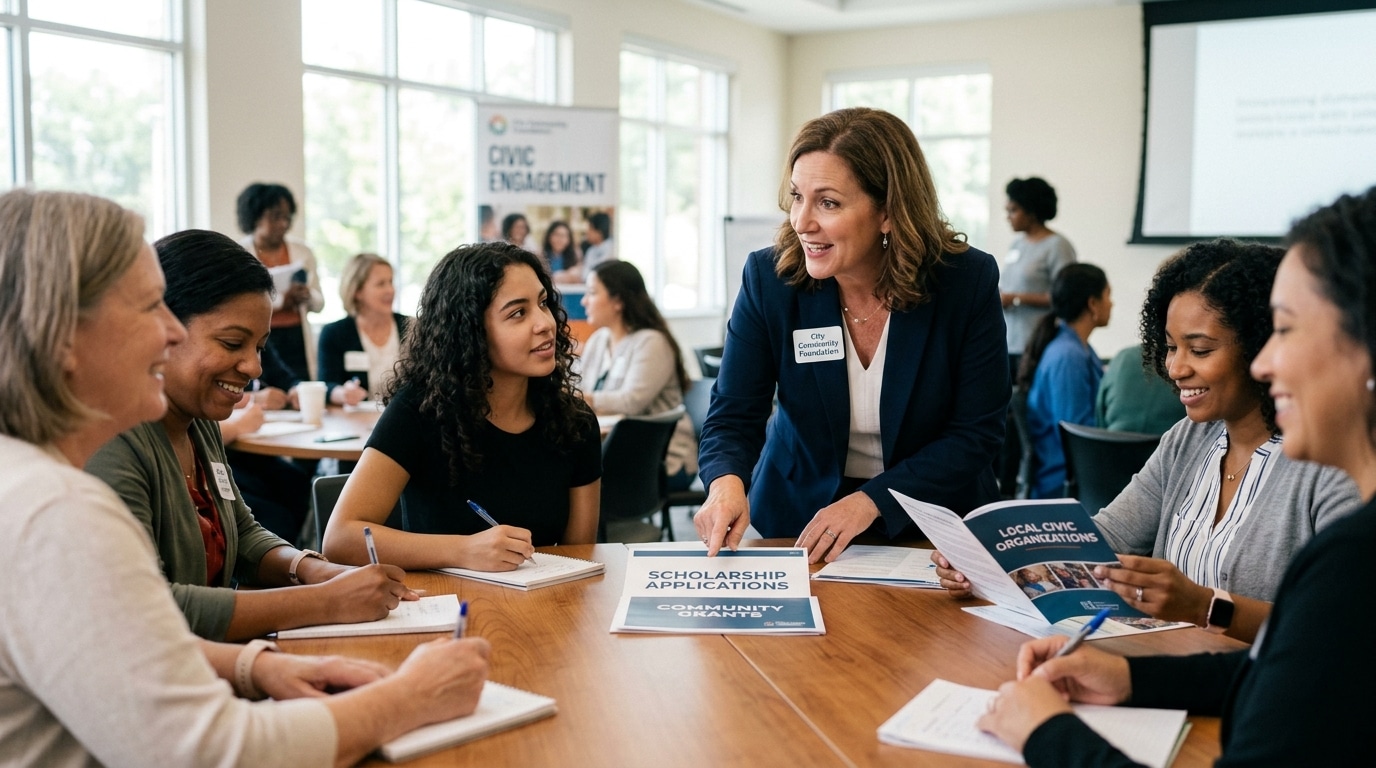
A significant and frequently overlooked category of financial aid for women comes not from national databases or large universities, but from the civic and philanthropic infrastructure operating within local communities. Community foundations across the country manage hundreds of individual scholarship funds on behalf of private donors, and many of those funds specifically prioritize women or include women as a preferred demographic. The Community Foundation of Southeast Michigan, for example, allows students to access dozens of distinct scholarship programs through a single application — a structure that dramatically reduces the time investment required to apply for multiple awards simultaneously. Similarly, community foundations in regions from Western Massachusetts to Greenville, South Carolina, maintain dedicated scholarship cycles that open in the first quarter of each calendar year.
Because community foundation scholarships are geographically restricted — often to a single county or group of counties — the applicant pool is inherently small. A woman who might struggle to stand out among thousands of national applicants can be highly competitive at the local level. Contacting your school’s financial aid office and asking specifically about local women’s scholarship funds is one of the fastest ways to identify these programs.
Women’s civic organizations add another productive layer to this search. The AAUW — which operates local branches in communities across the country — provides both nationally administered fellowships and branch-level scholarships tailored to regional students. The AAUW Naperville Area branch, for instance, offered a $5,000 STEM scholarship in 2026 for women pursuing STEM degrees at accredited institutions, along with a $2,500 “Future of America” scholarship recognizing two outstanding recipients. Other branches, such as the St. Paul AAUW Scholarship Trust, have awarded college scholarships to more than 400 local high school graduates and women returning to college since 1911. The Soroptimist organization is another civic body worth researching at the chapter level; its scholarship programs are specifically designed for women who are the primary financial provider for themselves and their dependents and who are pursuing undergraduate or career-training programs. Applications typically open in August and close in mid-November each year.
Scholarship Opportunities Designed for Returning and Nontraditional Women Students
The assumption that scholarships are primarily designed for students moving directly from high school to a four-year university is one of the most costly misconceptions in financial aid. In reality, a meaningful and growing segment of the scholarship market is explicitly structured for women who do not fit that profile. This includes women who stepped away from formal education to raise children, those who experienced financial disruptions, career changers pivoting to entirely new fields, and women in their 30s, 40s, and beyond who are pursuing their first postsecondary credential. These are not niche or marginal programs — they are well-funded, organized, and actively seeking qualified applicants who are often unaware that the funding exists.
The Jeannette Rankin National Scholar Grant, for example, provides up to $2,500 annually — and is renewable for up to five years — to women and nonbinary students aged 35 and older who demonstrate financial need and are pursuing a technical or vocational credential, an associate’s degree, or a first bachelor’s degree. The Patsy Takemoto Mink Education Support Award targets low-income women with children who are enrolled at nonprofit, accredited institutions. The Fresh Start scholarship program targets women in Delaware aged 20 and older who have experienced at least a two-year gap in their education — acknowledging that life circumstances, not lack of ability or motivation, are often what interrupt a woman’s educational path. For single mothers in particular, programs like the Soroptimist Live Your Dream Awards and the Patsy Takemoto Mink Foundation scholarship are among the most cited in this category. A direct search using the terms “women returning to school scholarship” paired with your state or region will surface a substantial number of programs that never appear in general scholarship search results.
Jeannette Rankin National Scholar Grant: Up to $2,500/year, renewable up to 5 years, for women 35+ pursuing a first credential or degree. Patsy Takemoto Mink Education Support Award: For low-income mothers enrolled at accredited institutions. Alpha Sigma Lambda Scholarships: Chapter-based awards from $1,500 to $3,000 exclusively recognizing nontraditional adult undergraduates.
Employer Tuition Benefits and Union Scholarship Programs Worth Pursuing
One of the most consistently underutilized sources of educational funding for women is sitting directly inside the benefits packages of their employers — or the employers of their parents. Labor unions in particular maintain scholarship programs that are open to members, their spouses, and their dependent children, yet these programs routinely go unclaimed simply because eligible people never ask about them. The Union Plus Scholarship Program, created by the AFL-CIO and administered through the Union Plus Education Foundation, has been supporting working families since 1991. In 2026 alone, the program awarded $300,000 across 181 recipients — with individual awards ranging from $1,000 to $4,000. Eligibility extends to current and retired members of participating unions, as well as their spouses and dependent children, provided at least one year of continuous union membership can be documented.
Union members can explore the Union Plus Scholarship Program directly. The application window opens in mid-