
The Difference Between Scholarships And Grants
Understanding how free college funding works and maximizing your financial aid opportunities in 2026
When navigating the complex world of college funding, understanding the difference between scholarships and grants can dramatically influence how effectively students pursue financial assistance. Both forms of aid share one critical advantage: recipients never face repayment obligations. Yet despite this shared benefit, these funding sources operate under entirely distinct frameworks, originating from different places and evaluated using separate criteria. Students who grasp these distinctions position themselves to capture substantially more free money for their education, reducing reliance on loans that accumulate interest over time. With tuition costs continuing to climb and over one hundred billion dollars in combined grant and scholarship funding distributed annually across American higher education, knowing where to focus application efforts represents a strategic advantage worth pursuing.
Financial Need as the Primary Driver for Grant Funding

Grants function primarily as need-based assistance, designed to help students from lower-income households access higher education they might otherwise find unaffordable. The federal government remains the largest provider of grant funding, with the Pell Grant program serving as the cornerstone of need-based federal aid. Eligibility determination relies heavily on information submitted through the Free Application for Federal Student Aid, commonly known as the FAFSA, which calculates a Student Aid Index reflecting a family’s expected financial contribution.
For the 2026-27 academic year, the maximum Pell Grant award stands at seven thousand three hundred ninety-five dollars, while the minimum award sits at seven hundred forty dollars. These figures, confirmed through the Consolidated Appropriations Act of 2026, reflect the ongoing federal commitment to supporting students with demonstrated financial constraints. State governments and individual institutions supplement federal grants with their own need-based programs, all typically drawing from the same FAFSA data to assess applicant circumstances.
One crucial aspect of grant funding that students frequently overlook involves annual reassessment. Family financial situations shift over time due to job changes, medical expenses, or other factors. Submitting the FAFSA each year ensures that eligibility receives fresh evaluation, meaning students who qualified for minimal assistance initially might receive substantially more in subsequent years if their circumstances change.
2026-27 Federal Pell Grant Parameters
The maximum Pell Grant award remains fixed at $7,395 for the 2026-27 award year, effective July 1, 2026 through June 30, 2027. Students attending additional terms within the same academic year may qualify for up to 150% of their scheduled annual Pell award through the year-round Pell provision.
Merit and Identity Form the Foundation of Scholarship Awards

Unlike grants, scholarships typically reward specific attributes, achievements, or affiliations rather than financial circumstances. Academic excellence represents one common criterion, with institutions and private organizations recognizing students who maintain strong grade point averages or achieve notable standardized test scores. Athletic prowess, artistic talent, and musical ability similarly attract scholarship funding from colleges seeking to strengthen their programs with skilled participants.
Beyond performance-based awards, numerous scholarships target particular demographics or backgrounds. Students pursuing specific majors, those belonging to certain ethnic or religious groups, individuals from particular geographic regions, and children of employees at specific companies all find dedicated scholarship opportunities. This diversity of criteria means scholarship hunting requires a more personalized approach than grant applications, with students examining their unique characteristics to identify matching opportunities.
The sources providing scholarship funding span an exceptionally broad landscape. Educational institutions themselves remain major scholarship providers, but employers, professional associations, community organizations, civic groups, and private foundations all contribute to the pool. Private sources alone distribute approximately 1.8 million scholarships annually, though only around seven to eleven percent of college students successfully secure private scholarship funding. This competitive environment rewards students who apply strategically and persistently rather than limiting themselves to a handful of applications.
The Scale of Available Funding
Combined grant and scholarship funding exceeds one hundred billion dollars annually in the United States. First-time undergraduate students who receive aid typically obtain between fourteen thousand and sixteen thousand dollars yearly, depending on institution type and state. Despite this availability, an estimated one hundred million dollars in scholarship funds goes unclaimed each year, often because qualified students simply never submit applications.
Where Grant and Scholarship Criteria Converge

While grants and scholarships maintain distinct primary purposes, many awards blend elements from both categories. Numerous scholarship programs require applicants to demonstrate financial need alongside meeting merit-based standards such as minimum grade requirements. Similarly, some grant programs incorporate academic performance thresholds that recipients must maintain to continue receiving funds.
This overlap creates opportunities for students who excel academically while facing financial constraints. Rather than viewing grants and scholarships as entirely separate pursuits, comprehensive financial aid strategies should address both simultaneously. Students meeting both need and merit criteria effectively double their potential funding sources, accessing programs that pure high-achievers from wealthy families or lower-performing students from modest backgrounds cannot reach.
Renewal conditions represent another area where grants and scholarships share common ground. Initial awards rarely guarantee continued funding throughout a student’s entire academic career. Both types of aid typically require recipients to maintain satisfactory academic progress, remain enrolled at qualifying institutions, and sometimes reapply annually. Understanding these ongoing obligations before accepting any award prevents unpleasant surprises when funding unexpectedly disappears mid-education.
GGrant Characteristics
Primarily need-based funding determined through FAFSA evaluation. Federal, state, and institutional sources. Eligibility reassessed annually based on current financial circumstances.
SScholarship Characteristics
Typically merit-based or identity-based criteria. Diverse sources including schools, employers, civic groups, and foundations. Highly specific eligibility requirements vary dramatically between programs.
Navigating the 2026 FAFSA Application Process
The FAFSA serves as the gateway to federal, state, and institutional financial aid, making completion essential regardless of expected need-based eligibility. For the 2026-27 academic year, the application launched in late September 2025, marking the earliest release in years following previous cycles plagued by technical difficulties and delays. Students now see their Student Aid Index and Pell Grant eligibility information immediately upon submission, eliminating the multi-day waiting periods that frustrated earlier applicants.
Several significant changes affect the 2026-27 FAFSA cycle. The One Big Beautiful Bill Act introduced modifications to Pell Grant eligibility criteria, including adjustments to how foreign earned income affects determinations. Asset calculations now exclude certain family-owned businesses with fewer than one hundred employees, family farms used as residences, and commercial fishing operations from net worth considerations. These exclusions potentially expand aid access for students from entrepreneurial or agricultural families previously disadvantaged by asset-heavy balance sheets.
Beyond federal aid access, FAFSA completion unlocks work-study opportunities and federal loan eligibility, making it valuable even for students confident they exceed income thresholds for grants. Additionally, many institutional scholarships require FAFSA submission as part of their application process, meaning students who skip the form inadvertently disqualify themselves from awards their academic credentials might otherwise secure.
Strategic Approaches to Scholarship Discovery
Effective scholarship searches require specificity rather than broad, generic queries. Students achieve better results by identifying awards matching their particular majors, hobbies, cultural backgrounds, career aspirations, or community involvements. Smaller, narrowly focused scholarships typically attract far fewer applicants than widely publicized national competitions, dramatically improving individual odds of success despite offering modest per-award amounts.
Consulting directly with institutional financial aid offices reveals automatically considered scholarships that require no separate application. Many colleges evaluate admitted students for merit-based institutional awards using admission application materials, meaning students sometimes receive scholarship offers without explicitly seeking them. However, additional opportunities requiring supplementary applications or essays often go unclaimed simply because students never inquire about their existence.
Parents’ employers frequently offer dependent scholarship programs that families overlook. Professional associations related to intended career fields, religious organizations, community service clubs, and local businesses all represent potential scholarship sources requiring targeted investigation. Building a diverse portfolio of smaller awards often proves more achievable than capturing a single large competitive scholarship, and cumulative amounts can substantially reduce educational expenses.
Essential Action Items
Complete the FAFSA annually regardless of expected eligibility. Contact your school’s financial aid office about automatic scholarship consideration. Search for awards matching your specific attributes and interests rather than generic scholarships. Reapply for renewable awards each year and monitor maintenance requirements.
Annual Renewal and Ongoing Eligibility Requirements
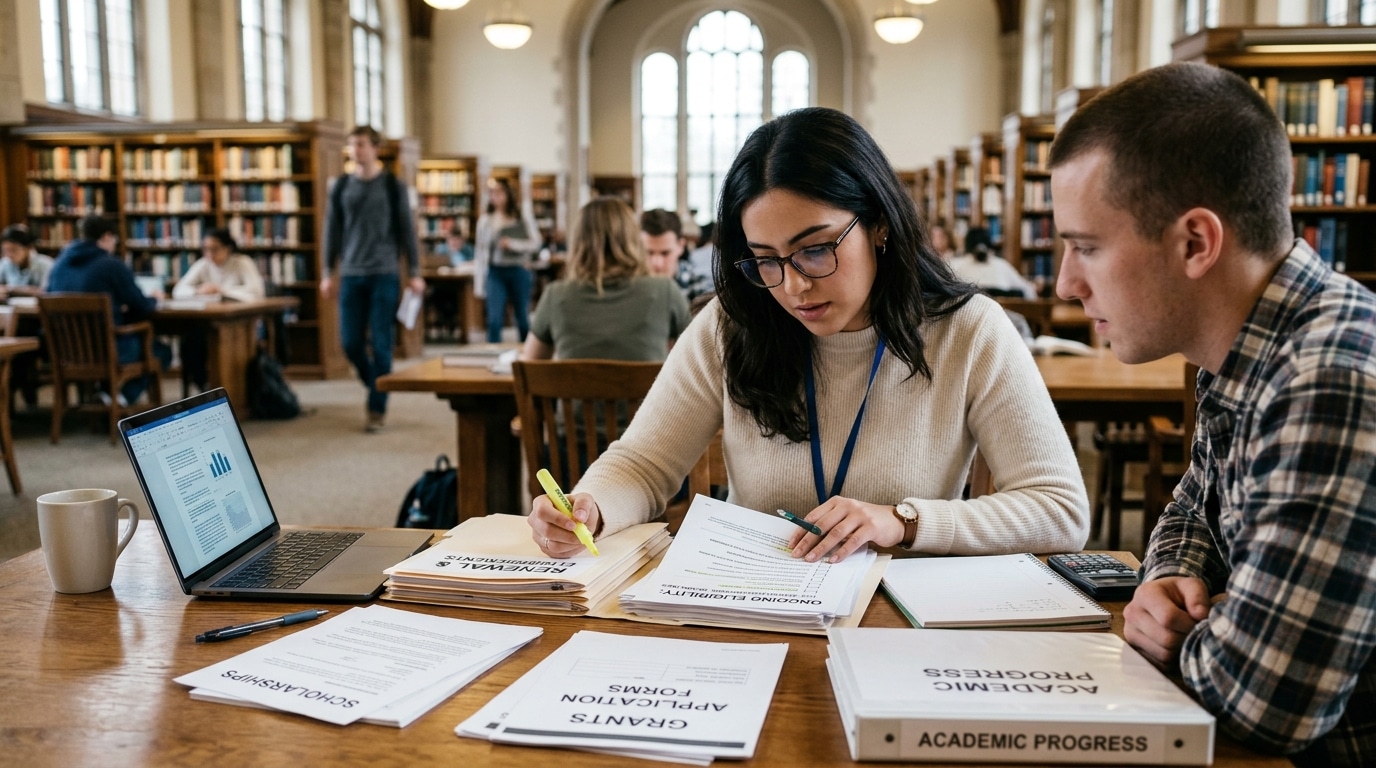
Both grants and scholarships commonly require annual renewal rather than providing guaranteed multi-year funding. Financial circumstances change, academic performance fluctuates, and enrollment patterns vary, prompting awarding organizations to reassess recipients regularly. Students who assume initial awards continue automatically often discover funding gaps when they fail to complete required renewal applications or fall below academic thresholds.
Federal grants undergo automatic reassessment through annual FAFSA submission, with award amounts potentially increasing or decreasing based on updated family financial data. Institutional and private scholarships may require separate renewal applications, recommendation letters, or documentation of continued eligibility. Carefully reviewing award terms upon initial acceptance prevents misunderstandings about ongoing obligations and protects against unexpected funding losses.
Grade requirements represent particularly common renewal conditions across both aid categories. Satisfactory academic progress standards typically mandate maintaining minimum cumulative grade point averages and completing specified percentages of attempted coursework. Students struggling academically risk losing financial aid precisely when they need support most, making early intervention through tutoring or course load adjustments essential for preserving funding alongside academic standing.
Maximizing Free Money for Higher Education

Pursuing both grants and scholarships simultaneously represents the most effective strategy for minimizing educational debt, as neither funding source requires repayment regardless of academic outcomes or career success. Students who invest time in understanding eligibility criteria, completing required applications, and maintaining renewal requirements position themselves to capture thousands of dollars annually in free educational funding. The effort required to secure grants and scholarships pales in comparison to the years of loan payments avoided, making persistent pursuit of these opportunities one of the most financially consequential decisions any college-bound student can make.